Without a doubt, the West Side Lumber Company had the single greatest impact on the history of the Tuolumne community. the importance of mining to Tuolumne’s economy diminished significantly when West Side built a sawmill on Turnback Creek and a narrow gauge logging railroad to reach timber land to the east.
The original developers of Sierra Railway and West Side Flume and Lumber Company, Carter Crocker, his cousin Henry Crocker, Charles F. Gardner, William Newell and Thomas S. Bullock, envisioned a connection between Sierra Railway and the narrow gauge logging railroad which would take passengers from the Bay Area and the Central Valley to tourists resorts they planned to build in Cherry Valley, Hetch Hetchy Valley and ultimately Yosemite Valley. However, those dreams…
…the former campus is now occupied by Mother Lode Christian School which respects and maintains its historical integrity.
The mill owners also built a three-story hospital and medical office at the corner of Carter and Bay Streets (now Reid Park) and hired Eugene H. Reid as the company physician. Dr. Reid established a private practice as well.
West Side and its logging railroad operated from 1901 until 1962 and had the greatest impact on Tuolumne’s economy and settlement of the community by other cultural groups. In addition to California natives from pioneer families, the mill drew immigrants from Italy, Ireland, Sweden, Germany, England, Mexico, Russia and Canada. the Italians, in particular, established a strong cultural community, running several restaurants, bars and boarding houses catering to mill workers.
The mill operations were sold to Pickering Lumber Company in 1925, but operations ceased during the Depression from 193 until 1934, when the former owners reacquired the property and, with the help of a $3.5 million Reconstruction loan, reopened timber operations.
Tuolumne townspeople celebrated the return of the industry and its jobs in June with a Lumber Jubilee, a tradition which continues today with a parade, lunber-themed contests, and a carnival, ending with the highlight Tug ‘O War competition.
West Side encouraged the community betterment and civic advancement of the town, from a swimming pool for local children to a town baseball team on an improved playing field to modern theater run by the local fire department.
In 1955, Pickering reacquired West Side, owning it until operations permanently ceased in 1962. In the 1970’s tourist train excursions and a theme park established by Taco Bell founder Glen Bell attempted to recapture the glory days of the West Side, but they were short-lived.
The former railroad right-of-way is now a popular 5-mile walking/bicycling/horse riding trail beginning at the trailhead on Buchanan Road and featuring interpretive signs about the railroad and logging operations.
West Side Exhibits
Exhibits and artifacts from the West Side era are found throughout the Museum.
Main Room: A roll-top desk, brought around the Horn for the home office of West Side’s president, William Thorsen is on display.
Family Room: A display is dedicated to the West Side’s physician, Dr. Reid, including instruments he used in his practice which were donated by his family. Reid Park, site of the former hospital and physician’s office, is named in his honor.
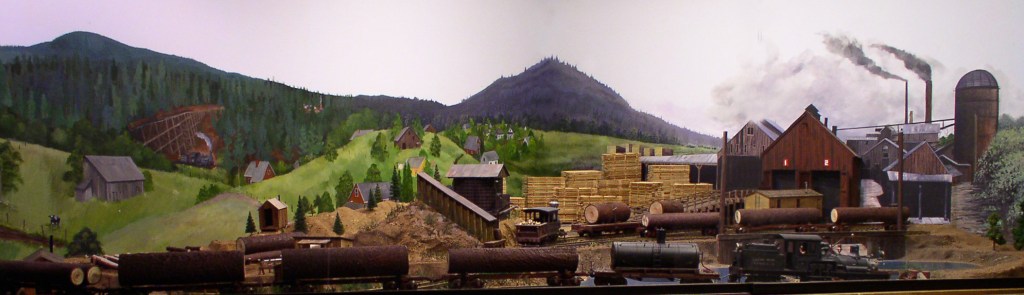
Train Room Gallery: The most popular is the working model of the West Side narrow gauge logging railroad which runs through a model of the mill site. The West Side narrow gauge logging railroad has a world-wider following of fans who create working models of its engines, log cars and the equipment and buildings which were used in logging camps and operations. A map shows the reach of the railroad and its logging camps into local timberlands. Also on display are wooden molds from the Tuolumne Foundry used to cast parts for train engines and the lumber mill.
Community Gallery: Featured is a wall-sized mural of the log pond, a video of logs being dumped from a train into the pond, photographs of the mill, logging operations and the West Side building, as well as a variety of artifacts from these operations. Pictures of a 1950’s era Lumber Jubilee Tug ‘O /war contest and the first two Jubilee queens.

